

 WaZappy
 Himanshu Chawla

Building a new business web application? Two popular choices for backend development are Laravel and Node.js. Both are powerful, but they cater to different needs and development styles. Understanding their strengths and weaknesses is key to picking the right one for your project.
Key takeaways
- Laravel is a PHP framework known for rapid development and a structured approach.
- Node.js is a JavaScript runtime environment, ideal for real-time applications and microservices.
- Choose Laravel for projects needing quick iteration, strong community support, and a clear MVC structure.
- Opt for Node.js when building high-performance, scalable, real-time applications, or if your team is JavaScript-heavy.
What are Laravel and Node.js?
Laravel is a free, open-source PHP web framework. Think of it as a set of tools and conventions that make building web applications with PHP much faster and more organised. It follows the Model-View-Controller (MVC) architectural pattern, providing a solid structure for your code.
Node.js, on the other hand, isn't a framework itself but a JavaScript runtime environment. It lets you run JavaScript code on the server, outside of a web browser. This means you can use JavaScript for both frontend and backend development, which is a big advantage for many teams. Common frameworks built on Node.js include Express.js, NestJS, and Koa.js.
Core Differences
The fundamental difference lies in their languages and execution models.
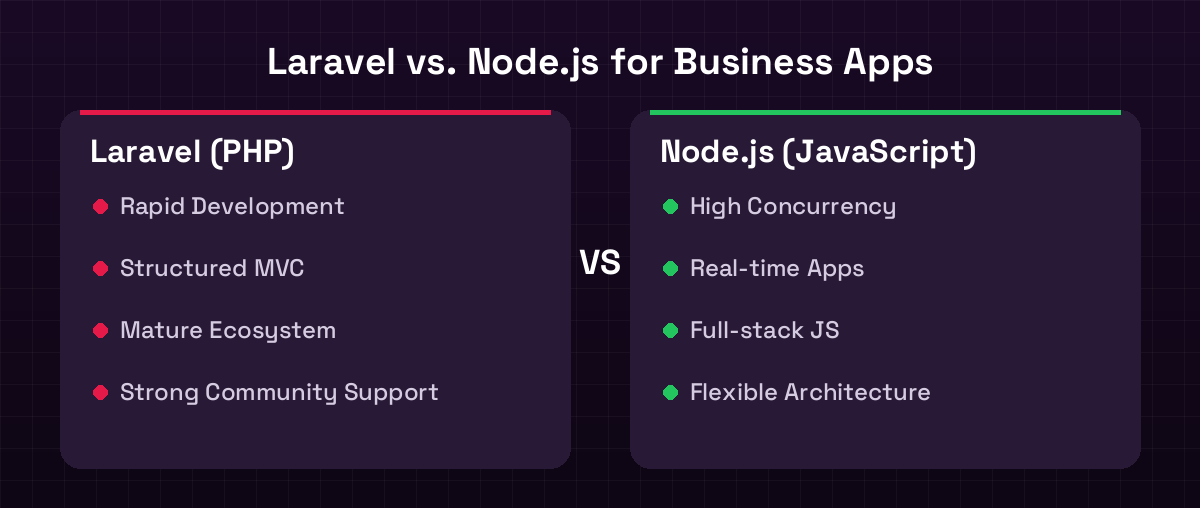
Laravel (PHP)
- Language: PHP, a mature language with a vast ecosystem.
- Architecture: Primarily follows MVC, promoting organised code.
- Ecosystem: Rich set of built-in features (ORM, templating, routing, auth).
- Community: Large, active community, abundant tutorials and packages.
- Learning Curve: Generally easier for beginners due to clear structure.
Node.js (JavaScript)
- Language: JavaScript, ubiquitous in web development.
- Architecture: More flexible, often uses non-blocking, event-driven I/O.
- Ecosystem: Huge package repository (NPM), but can be fragmented.
- Community: Massive and growing, but can be more varied in quality.
- Learning Curve: Can be steeper due to asynchronous nature and flexibility.
Performance and Scalability
When it comes to performance, Node.js often has an edge, especially for applications requiring high concurrency and real-time features. Its non-blocking, event-driven architecture excels at handling many simultaneous connections without getting bogged down.
Laravel, being a traditional PHP framework, typically uses a synchronous, request-response model. While modern PHP versions and Laravel's optimizations have improved performance significantly, it might not be the first choice for extremely high-traffic, real-time applications like chat services or live gaming platforms.
However, scalability is not just about raw speed. Both can be scaled effectively. Node.js scales well horizontally by adding more servers. Laravel applications can also be scaled, often by optimising database queries, using caching, and employing load balancing. For many typical business applications, either can be scaled to meet demand.
Development Speed and Ease of Use
Laravel is renowned for its developer-friendliness and features that accelerate development. Built-in tools like Eloquent ORM, Blade templating engine, Artisan CLI, and authentication scaffolding significantly reduce the amount of boilerplate code you need to write. This makes it excellent for getting an Minimum Viable Product (MVP) out quickly.
Node.js, especially with frameworks like Express, also allows for fast development. If your team is already proficient in JavaScript, you can leverage that expertise across the full stack. The vast NPM ecosystem provides libraries for almost anything, but managing dependencies and choosing the right tools can sometimes add overhead.
When to Choose Laravel
You should strongly consider Laravel for your next project if:
- You need to develop a web application quickly, perhaps an MVP.
- Your application involves standard web features like user authentication, forms, CRUD operations, and content management.
- You value a well-defined structure and best practices out-of-the-box.
- Your development team has strong PHP expertise or is comfortable learning it.
- You need extensive community support and a wide range of readily available packages.
- Your project doesn't heavily rely on real-time, high-concurrency features.
Laravel is a fantastic choice for custom web development projects such as e-commerce platforms, content management systems, internal business tools, and client portals where structure and rapid iteration are priorities. You can learn more about our approach to Custom Web Development.
When to Choose Node.js
Node.js is likely the better fit if:
- Your application requires real-time functionalities (e.g., chat apps, live dashboards, online gaming).
- You need to build microservices or APIs that handle a high volume of concurrent requests.
- Your team is already proficient in JavaScript and you want to use it across the entire stack.
- You are building a single-page application (SPA) where a JavaScript backend can streamline development.
- Performance and scalability under heavy load are critical requirements.
- You need flexibility in your architecture and are comfortable managing a more diverse set of tools.
Node.js is ideal for building applications like streaming services, collaborative tools, IoT platforms, and complex APIs where speed and handling many simultaneous connections are paramount.
The Verdict
Both Laravel and Node.js are excellent technologies, but they serve different primary purposes. Laravel offers a structured, efficient path for developing robust web applications, especially when speed to market is important. Node.js provides unparalleled flexibility and performance for real-time, high-concurrency scenarios and for teams committed to a JavaScript-centric stack.
Your decision should align with your project's specific requirements, your team's expertise, and your long-term scalability goals. For many businesses, a hybrid approach or careful consideration of the core needs of the application will lead you to the right choice. We at Infrared Techno have experience with both stacks and can help you build the right solution for your business.