
 WaZappy
 Himanshu Chawla
Your business has unique information, processes, and policies. When you deploy an AI chatbot, you need it to reflect that reality accurately. Retrieval Augmented Generation (RAG) offers a way to build chatbots that stick to your company's specific knowledge base, ensuring reliable answers and preventing embarrassing mistakes.
What is a RAG Chatbot?
Imagine you have a massive library of company documents: manuals, reports, FAQs, product specs. A RAG chatbot is an AI system designed to read and understand this library. When a user asks a question, the RAG system first searches your documents for relevant information. Then, it uses that retrieved information to generate a precise answer. It's like having a super-fast research assistant who only consults the books you give them.
The 'Retrieval' part means finding the relevant text snippets. The 'Augmented Generation' part means using those snippets to create a new, coherent answer. This is different from older AI models that might just try to guess an answer based on general knowledge.
Why Limit Answers to Your Documents?
This is the core advantage of RAG for businesses. By design, you can configure a RAG chatbot to *only* use the data you feed it. This prevents several common and costly AI failures:
1. Hallucinations and Fabricated Information
Large Language Models (LLMs), the engines behind many AI chatbots, can sometimes 'hallucinate'. This means they make up facts or provide information that sounds plausible but is completely false. If a general-purpose AI chatbot is asked about your company's return policy, it might invent one based on common retail practices, which could be entirely wrong for your business. A RAG chatbot, restricted to your internal documents, won't invent a policy; it will either find your actual policy or state that it doesn't have the information.
2. Outdated or Incorrect Information
Company information changes. Product features update, prices shift, policies are revised. If your chatbot relies on its pre-trained general knowledge, it will likely be out of date. A RAG system, when properly maintained, always refers to the latest versions of your documents. You update the documents in its knowledge base, and it starts answering with the new information.
3. Brand Misrepresentation and Compliance Risks
Imagine an AI chatbot giving a potential customer incorrect pricing or misleading product details. This can lead to lost sales, customer dissatisfaction, and even legal issues. For regulated industries, providing inaccurate information can have severe compliance consequences. A RAG chatbot, by staying within the bounds of your approved documentation, significantly reduces these risks.
4. Irrelevant or Generic Answers
Users come to your chatbot for specific answers related to your business. If the bot provides generic information that could apply to any company, it's not very helpful. RAG ensures answers are tailored to your context, using your company's terminology, examples, and procedures.
Key takeaways
- RAG chatbots retrieve information from your specific documents before generating answers.
- This approach significantly reduces AI 'hallucinations' and fabricated information.
- Answers remain accurate and up-to-date by referencing your latest company data.
- It mitigates risks of brand misrepresentation and compliance failures.
- RAG chatbots provide context-specific, relevant answers tailored to your business.
Failure Cases: What Happens Without Document Restriction?
Let's look at some scenarios where a non-RAG or improperly configured RAG chatbot can fail:
- Customer Support Bot: A customer asks about the warranty period for Product X. The bot, trained on general web data, states "most electronics have a 1-year warranty." Your actual warranty is 2 years. This leads to customer confusion and potential disputes.
- Internal HR Bot: An employee asks, "How many days of paid leave do I get?" The bot, lacking access to specific HR policies, might provide a common average or make something up, causing distress and potential HR issues.
- Sales Assistant Bot: A prospect asks, "What's the price for the Enterprise plan?" The bot, not connected to your pricing sheets, might guess a lower price, leading to a lost deal when the actual quote is higher, or an unprofitable deal if it quotes too low.
- Technical Support Bot: A user asks, "How do I reset the password on the XYZ software?" The bot, not referencing your specific user manual, might suggest a generic password reset method that doesn't work for your software, frustrating the user and increasing support tickets.
These failures aren't just inconvenient; they can damage your reputation and cost you money. This is precisely why we focus on building AI chatbots and knowledge assistants that are grounded in your business's truth.
How RAG Ensures Accuracy: The Process
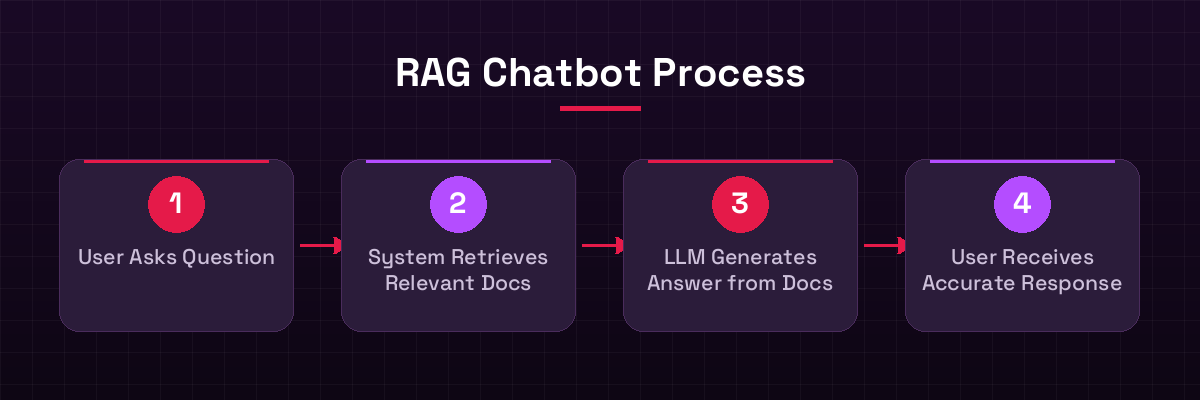
A typical RAG system works in a few key stages:
- User Query: The user asks a question (e.g., "What is our company's policy on remote work?").
- Retrieval: The RAG system searches your curated knowledge base (your documents) for the most relevant passages related to "remote work policy". This might involve advanced techniques like vector embeddings to find semantic similarity.
- Augmentation: The retrieved text snippets are combined with the original user query. This forms a new, more detailed prompt for the LLM. For example: "Based on the following text: '[Snippet 1 about remote work policy]', '[Snippet 2 about remote work guidelines]', answer the question: 'What is our company's policy on remote work?'"
- Generation: The LLM generates an answer based *only* on the provided context (the retrieved snippets) and the refined prompt. It doesn't access its general knowledge for the answer itself.
- Response: The generated answer is presented to the user.
Building Your Document-Grounded Chatbot
Implementing a RAG chatbot involves several steps:
- Identify Your Knowledge Sources: Gather all relevant documents – PDFs, Word docs, website content, internal wikis, databases.
- Prepare and Index Data: Clean the documents, break them into manageable chunks, and create an index (often using vector embeddings) that allows for fast searching. This is where the 'Retrieval' happens efficiently.
- Choose an LLM: Select a suitable Large Language Model. The choice can depend on cost, performance, and specific requirements.
- Configure the RAG Pipeline: Set up the retrieval mechanism and the generation prompt to ensure the LLM is instructed to use *only* the retrieved context. This is a critical configuration step.
- Testing and Refinement: Thoroughly test the chatbot with various queries to ensure accuracy, relevance, and adherence to your data sources. Refine the indexing and prompting as needed.
When Might a General AI Bot Be Enough?
For tasks that require general knowledge, creative writing, or brainstorming without reliance on specific company data, a standard LLM chatbot might suffice. However, for any application where factual accuracy related to your business operations, products, or policies is paramount, RAG is the superior and safer approach.
Conclusion
For businesses, an AI chatbot is an investment. You want it to be a reliable asset, not a source of misinformation. RAG chatbots, by design, ensure that your AI assistant speaks with the voice of your documentation. This grounded approach prevents hallucinations, guarantees accuracy from your specific data, and protects your brand. If you need an AI chatbot that answers only from your business documents, RAG is the technology you need.